haikus for distance learning

each section is based on the oxford english dictionary’s word of the day from september, 2020.

i. delibation, n.

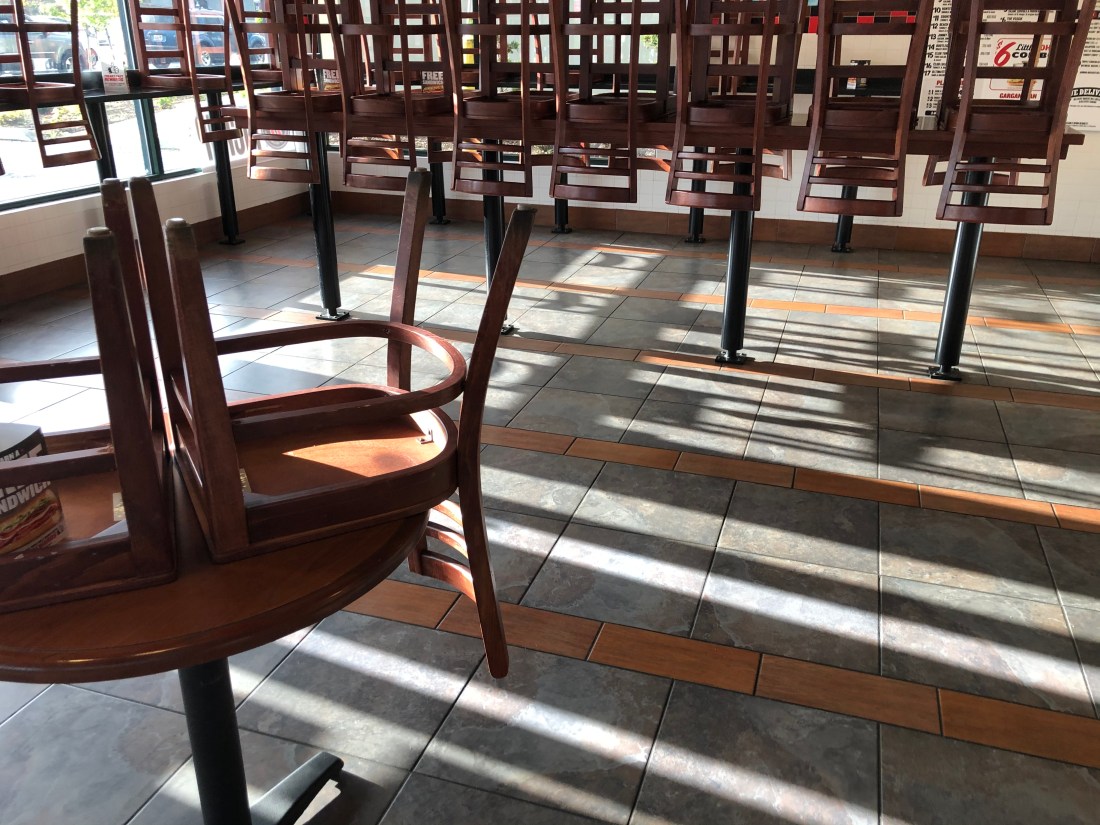
dim empty classroom
desks shoved together chairs stacked
you’re alone in here

ii. situla, n.

yawn walk brew sit
meeting in fifteen minutes
you need to wake up

iii. smack talk, n.

a grid of faces
nodding and mumbling about
low expectations

iv. chin-stroking, n.

should you say something
they all seem to agree
maybe you don’t know

v. bird colonel, n.

your principal
closes with encouraging words
a hurricane’s eye

vi. croquembouche, n.

mailbox run before first class
a stack of cans along the top
it might not be so bad

vii. wallyball, n.

first live lesson
camera chat emails lecture
ricochet endlessly

viii. coze, v.

office chair swivels
does not move away from the desk
vines around your legs

ix. dep, n.

you try to build bridges
with students made of pixels
something’s lagging

x. ruby murray, n.

in your eye’s corner
relics from previous students
convoluted contexts

xi. walklet, n.

passing period
mask up stretch your legs in the hall
see only ghosts

xii. pronoid, n.

no laughs after your jokes
all thirty-eight students muted
you’re sure you’re funny though

xiii. sea-puss, n.

your eyes strain head aches
dim your screens close the blinds blink slow
fight against the current

xiv. gypit, adj.

you cover your desk
with toys you name and talk to
stave off loneliness

xv. yat, n.

use abbreviations
codes other learning tools
make something together

xvi. chritophany, n.

look into the ceiling
a smile there says you’re doing great
maybe just seeing things

xvii. dulciloquy, n.

afternoon classes with
faces tired anxious sad
help them feel welcome

xviii. cannet, n.

last class ends you sit
first time in what feels like days
lump of exhausted flesh

xix. transitarium, n.

fight sleep need to plan
figure out how to help your kids
sketch diverging scaffolds

xx. ambidexterity, n.

talk chat help assess
teacher counselor tech support 
you wear so many hats

xxi. rooked, adj.

cover your walls
with your students's artwork
it’s their house too

xxii. headwark, n.

temples in a c-clamp
eyes gripped in wool mittens
too much screen time

xiii. pupil-monger, n.

wake up the next day
ready to try it all again
always getting better

xxiv. kibitz, v.

a tech issue
try turning it off then back on
a rote response

xxv. nutual, adj.

you blank on a word
wave your arms to convey its meaning
somehow they get it

xxvi. titanolatry, n.

think before you speak
they’ll remember how they felt here
don’t be that white guy

xxvii. adimplete, v.

log in see hundreds
of messages in your inbox
monday morning

xxviii. antennation, n.

sit for an hour
grade respond delete archive
reach them as best you can

xxix. arr, int.

spirit week hat day
make do with what you have
take pride in your work

xxx. ruderal, adj. and n.

this year isn’t
what you thought it to be
dig your roots deep

i sped down the highway

i sped down the highway
standing in my kitchen

my heart
a crash test dummy’s head bouncing off the windshield

phone in hand
a ghost escaped the teakettle

the ringtone
layered sirens from emergency vehicles

your name
strobing lights from a police car

phone dropped to the floor
waves across the lake surface

who cooks for you? who cooks for you-all?

old north wind
rattles leaves from their stems
grey feathers
line my jaw and ears

who cooks for you?
who cooks for you-all?

full moon rises
my talons itch
i call out to the shadows
only hear echos

who cooks for you?
who cooks for you-all?

a splash near the riverbed
a bob of an alder branch
a twitch in the undergrowth
a corpse by the highway

who cooks for you?
who cooks for you-all?

About the Future

Sometimes,
when you think of the future,
you see all the branches—
          all the if-thens—
trunk to branch to stem.

Sometimes,
when you think of the future,
all the branches look barren—
no fruit or flower or leaf.

Somewhere,
in the temporal pathways,
you breech the outer bark,
prune branches.

Somewhere,
in the temporal pathways—
          if you squint—
on the edge of the smallest lateral,
a bud blooms.

Doing the Work

Each section is based on the Oxford English Dictionary’s word of the day from July, 2020.

I. Delectus, n.

With Will going to Basic Training this fall,
his old Camry would just sit in the garage
for who knows how long, especially
if he gets stationed somewhere far away.
So, naturally, I asked him
if I could have the car.

“You can’t even drive yet.”
He shakes his head,
looks back at his phone.

“But I’ll be able to soon. You know
my birthday is at the beginning of September.
I can take the test then.”

He scratches his head.
“Why can’t you just use Mom’s car?
That’s what you practice on.”

“I won’t be able to drive that car
to school, Will.
I’d need it to get a job, too.
Come on.”
I feel my back tighten. 

He sighs, rolls his eye.
“Fine, Nate. But—“

I freeze mid-fist pump.

“You have to earn it.”

“What?”

“Being goal-oriented,
showing determination, grit
are values I wish I had learned
when I was your age.
What kind of big brother would I be
if I didn’t try to help you grow, y’know?”

“You’re serious? I need to pay for it?
How much?”

He types and scrolls on his phone.
“Kelley Blue Book says
the car is worth $2000.”
He raises his eyebrows,
sees my eyes widen.
“I’ll give you the family discount of $1000.
You have two months of summer left.
It’s possible.”

I exhale through my nose.
“Fine. If you say so.”

“I do. Deal?”
He sticks his hand out to shake on it.

I grab his hand.
“Deal.”

II. Coxcombery, n.

Of course he would get on some sort of
high-horse nonsense
in this whole thing.
Always has to have the moral high ground.

I lie in bed, stare at the ceiling, brainstorm.
What can I do to get some cash?
Yard work is obvious.
People probably don’t want
a stranger cleaning their house.
I can walk dogs?
Keep it vague.

I get a piece of paper out of Mom’s printer,
a sharpie and a roll of tape from a drawer in the kitchen,
make an ad for help with “odd jobs”
with my name and number on it,
tape it to the side of the neighborhood mailbox.

III. Jibbons, n.

Mrs. Plover
is a retired nurse who
lives in the house at the end of the street.
She’s the first person to call me,
says her vegetable garden needs tending.

“Be careful with those,” she calls
from her lawn chair, maskless,
as I turn some dirt.
“I started those as seeds in an Aerogarden
my daughter got me for Christmas.”

“The stalky things?” I ask.

“Yes.
They’re spring onions,” she answers,
looks at the clouds in the sky.
“I transplanted them a few months ago,
just after quarantine started.
Hurt my knee somethin’ fierce that day.
Haven’t been able to work
that low to the ground since.”

“I’m sorry to hear that, ma’am.
Would you like anything else done
when I’m finished with your garden?”
I spread compost between rows of stalks,
holding my breath best I can.

“Not today, Nathaniel.
Maybe something will come up soon.”

“Just let me know. I can help with
whatever you need.”
Whatever can get me paid.

Mrs. Plover nods, smiles, closes her eyes,
takes a deep breath of the summer air.
“That’s nice of you,” she says
in a tired voice
as she relaxes in her chair
and falls asleep.

IV. Ambigue, n.

Just gonna be honest:
I think Mrs. Plover gives me work
so she has someone to talk to.

The day after I work in her garden,
she asks me to take out
the weeds in her front yard.

She sits in a camping chair
by her front door as I work,
talking about her favorite books.

she gets quiet as the Danielson’s
park their Explorer in their driveway.
They wave as they walk inside.

She waves back, watches them
enter their house down the street
on the other side of the mailboxes.

“Never felt very sure about
those Danielsons,” she says.
“I’ve dealt with people like them before.”

I put a handful of dandelions in the bag,
wipe my forehead with the hem of my shirt.
“What do you mean?” I ask.

“At the hospital,” she says. “People like them
would always exaggerate their pain
for prescription drugs.”

Don’t know how to respond to that.
“That certainly sounds frustrating,”
I say, bending down to pull up more weeds.

V. Brigue, n.

My relationship with Jessica
has been rough
during quarantine.
She wants to FaceTime every day,
which I’ve been happy to do,
but now we can’t do that as often
since I started doing work
around the neighborhood.

Last night was bad.
I was exhausted
after weeding Mrs. Plover’s yard,
and I started falling asleep
on the call
while Jessica told me about her day.

She was upset, said
it’s apparent
she’s not important
to me.

I told her
I need the money, but
that wasn’t a good reason
to her.

VI. Alembic, n.

The summer sun,
alone in a cloudless sky,
relentless
as I mow yards of several houses.

On my break, I look at my phone to
check for more jobs,
check how much I’ve made,
calculate how much I need to make
per day
to stay on track.

I drink some water,
wipe sweat from my brow,
wring sweat from my mask, then
push my lawnmower to the next house.

VII. Ambarvalia, n.

Sacrifice.
How does she not get it?
I know it’s hard now, but
the benefits of having access to a car
infinitely outweigh
the current burden.

VIII. Thingism, n.

After a week of working around the neighborhood,
Mrs. Plover asks me to mow her yard.

She offers me a glass of water when I’m done,
cold and damp with condensation.

She takes a sip of her glass, shakes her head.
“So materialistic,” she sneers. “Vain.”

I follow her gaze to the Danielson’s driveway,
see Mrs. Danielson behind their Explorer

load her arms with canvas bags full of groceries
out of the trunk to avoid a second trip.

I take a long drink of water.
“Mrs. Danielson?” I ask.

“The whole family,” she says.
“Spending their money on such frivolous extravagance.”

I can see the Kroger-brand chip bag
peaking out of one of her bags.

“Are you sure?” I pause.
“Seems like normal groceries to me.”

“It’s not just the groceries, Nathaniel.
It’s everything. They always flaunt their wealth.”

I look at their house and yard—
identical to every other one on the street.

“Huh,” I shrug, finish my water,
thank her, get my money, leave.

IX. Ayuh, adv.

I was a bit surprised
when Mr. Danielson called me
to mow their backyard.

I don’t know why.

I guess I assumed that
they wouldn’t need the help
based on how much money they have.

That’s what Mrs. Plover said.

Even if
it’s just a pity thing,
it’s still money.

I accept the job.

X. Nomina Sacra, n.

When you go to a rich person’s backyard,
you expect to see fancy stuff—
a pool or a tennis court or whatever.

But,
the Danielson’s yard
looks just like ours.

A clothesline stretched to the back fence,
lawn chairs on their small patio by
an upturned cornhole board.

Above it, next to the sliding glass door
a placard that says
“OKE” with a line over it.

Mr. Danielson
catches me staring
as he winds up the garden hose.

“You alright?” He asks,
setting the hose behind their barbecue.
He wipes his hands on his jeans.

“Uh, yes, sir,” I stammer. “Sorry.”
I shake my head.
“Just admiring your yard. It’s nice.”

“Thank you, Nathan.”
He tilts his head at the placard.
“You have no idea what that says, right?”

I blink, shake my head.
“No sir.
I was curious.”

He chuckles. “No one ever does.
It’s an abbreviation for ‘Mother of God’
in Greek. Reminds us to be thankful.”

“Oh cool.” I nod, look at it again,
then around the yard. “I didn’t realize
how similar all of our yards are.”

“Really?” He laughs.
“They don’t make special houses
for Black people.”

XI. Dreich, adj.

When I was young,
my mom scolded me
when I asked about race
at all.

“That’s rude,” she’d say, 
then apologize to
whoever I asked about,
whoever was around.

“You judge a person
by the content of their character,
not the color of their skin,” she’d say;
something that was echoed by
every teacher I had in elementary school
in the month of January.

XII. Bricole, n.

I stammer through an apology
as an automatic response.
“Oh, sir, I’m so sorry.
I didn’t mean to imply—
I was just—
I’m sorry, sir.”

Mr. Danielson laughs so hard,
he bend over, hands on knees.
After a deep breath, he says,
“Don’t sweat it , Nathan.
You’re not the first white boy
to assume racist stereotypes about us.”
He wipes a tear from his eye.
“I just like messing with you guys.”

“No, sir, please.”
I shake my head,
wave my hands like windshield wipers.
“It wasn’t
about race at all,
I swear.”

“Oh, it wasn’t?” He asks skeptically.

“Not at all, sir. I just thought—“
It turns out, this is
even more awkward
to say out loud.
“I thought your family was wealthy, sir.”

Shames washes over me.
First, talking about race.
Then, talking about money.
My parents would disown me.

Mr. Danielson
furrows his brow, leans back.
“What
would have made you think that?”

XIII. Pacation, n.

I did my best
to end the conversation
as quickly as possible.

“I’m not sure, sir,” I told him,
seeing Mrs. Plover’s scowl in my head.

“Well, it’s alright, I guess,”
Mr. Danielson said, confused.
“Don’t worry about it,”
he added, his hand on my shoulder.
“You’re young
and have plenty still to learn.
Just be conscious. 
You’re a good person; I can tell.”

I swallowed guilt
as he pointed around the yard
to warn me about molehills,
soft patches that might need an extra push
as if nothing had happened.

XIV. Bastille, n.

I finish mowing the yard, hurry home.

Once in my room,
I put Mr. Danielson’s ten dollars
in an old Folgers tin,
update the running total
on a sticky note under the lid—
only a third of the way there.

I take my phone out of my pocket,
see multiple messages from Jessica,
lay it face down on across my bed.

I lie down and stare at the ceiling.
How had I never realized
the Danielsons were
the only Black family in our neighborhood?
Why did Mrs. Plover
say those things about them?

How much do I not know?

XV. Travertine, n.

I do only thing I can think to do:
Talk to my mom to figure things out.

“Nathan, it’s inappropriate
to talk about such matters,”
she responds immediately.

As I expected.
So, I try my brother.

He shrugs.
“I don’t know, Nate.
Mrs. Plover was a nurse for forever.
I think she’d know
what she’s talking about.”

Something still feels wrong.
I talk to Jessica.

“I don’t see why you have to
make it all about race.”
She shakes her head.
“It could be anything,
like their jobs or whatever.
Or maybe they’re from Tacoma.”

XVI. Staycation, n.

My turn to do the dishes
after dinner.
My phone face-up by mom’s coffeemaker
next to the sink.

A notification for a voicemail from
Mrs. Plover
stares at me—
an angry cat’s eye, blood red.

I wet the sponge, squirt soap
onto the baking sheet.
I scrub the sheet in small circles
slowly growing bigger.

When she called,
I dropped my phone on my comforter,
let the ringtone echo
until it ended on its own.

I’ll say I was busy.
I’ll say I needed a break.
I’ll say my mom needed my help.
I’ll say—

XVII. Simplicitatrian, n.

I turn off the faucet,
drain the sponge in my hand.

I place it in the holder,
and a gleam travels across the room

from my dad’s dog tags
hanging on the key rack by the front door.

I stand frozen at the sink.
He would be so ashamed.

He was direct, cut through
pleasantries when he needed to

address something or someone.
I need to be more like that.

XVIII. Bombogenesis, n.

Mrs. Plover asks me
to sweep out her garage,
clear her driveway, admitting
to looking for chores to “help
such an industrious boy like yourself.”

Before going to her house,
I rehearse a bunch of “call ins”
that I found online to be more polite,
just in case.

I collect dead leaves and broken twigs
in a dustpan behind her Volvo
when she finally makes a comment
about the Danielsons.

“Those Danielsons
always play their music so loud.”
She shakes her head,
places a palm over one of her ears.

I empty the dustpan into her garbage bin,
look down the road.
The Danielson kids were
drawing with chalk in their driveway.
A rumbling bass vibrated
the frame of a car further down the road.
Familiar—
a Camry. Will’s Camry.

“That’s not the Danielsons, ma’am.
It’s my brother Will’s car;
he must be vacuuming it out
and turned it up.”

“Hmm.” She squinted to
see the source of noise.
“You might be right, but
that family
does have a habit of being way too loud.
So inconsiderate.”

I gulp.
“Mrs. Plover, I don’t mean to be rude, but
I’ve never noticed the Danielsons
making any sort of noise.”

“You haven’t??” She asks, aghast.

“No, ma’am.
It usually my brother Will, I notice,
playing his music so loud.
Just because it’s hip hop
doesn’t mean
it’s the Black family playing it.”

She leans back in her chair,
clasps her hands in her lap.
“I hadn’t thought of that,” she says slowly.
“Thank you for that insight, Nathaniel.”

XIX. Abrodietical, n. and adj.

For the next week,
Mrs. Plover doesn’t call.

For the next week,
fewer people called
in general.

Maybe
people are vacationing
or on road trips.
Hopefully.

XX. Don’t-carishness, n.

Most people stopped calling.
I see them
around the neighborhood
when they said
they’d be out of town.

So what?
It’s nothing.
I can still do it.
There’s definitely something
I can do.

XXI. Ryotei, n.

Jessica tells me about
the restaurant she and her parents went to.
Some place with a French name
I don’t know the letters for,
finally accepting reservations
after reopening
from the coronavirus closure.

My eyes dart between
her FaceTime window
and
my half-empty Folger’s tin.

She talks about
eating on their patio
under a forest green umbrella,
the sun setting over the sound
as her parents clink crystal glasses.

I chew
the inside of my lip.

XXII. Taffetine, n.

The only people who call anymore
are the Danielsons.

Mrs. Danielson asks for help
putting laundry on the line
in their backyard.

“The factory is hell on my shoulders
some times,” she says,
placing a bin on the grass.
“With all the orders Amazon gets lately,
it’s been real bad.”
She rubs her left shoulder
with her right hand,
her elbow like a bird’s beak.

“Of course, ma’am,” I say,
picking up a shirt.
“Do you want them spaced a certain way?
Or, like, hung some way?”

She flicks her wrist at me.
“Psh! As long as they’re all up,
doesn’t matter.”
She winces, holds her shoulder.
“After a few hours,
you can come back and pick ‘em up.
I’ll have the girls fold ‘em;
they need to earn their keep.”
She smirks.

“No problem.”

Stiff clothespins over the taught line,
high over the yard.
I have to stand on the tips of my toes
to hang a pair of jeans.

I pick up a scarf,
a deep blue,
no end, a complete circle,
so soft in my hands.

Felt like holding 
a target and 
a halo and 
the ocean and
a band that holds us all together

all at once.

XXIII. Coulrophobia, n.

Since I started working
for the Danielsons,
it’s felt like
a floodlight flipped on—
I can see so much more than before.

Comments
from my mom,
from my brother,
from Jessica and her parents,
from my friends on Instagram
echo
Mrs. Plover.

I always hesitate,
aware that my lack of work
is directly related to
how I responded to her,
aware that people who do respond
are insulted, ridiculed,
drowned in torrents of
trite clown emojis and memes.

So, my thumbs
hover over an open keyboard
as I look out my window,
down the street,
to see Erica, the youngest Danielson,
riding her trike around the mailboxes
across the street from her house,
up and down the sloped curb
in constant circles.

XXIV. Fakement, n.

Maybe
I need to just act
like a garbage white person
to get the work.

Michael Jordan once said,
“Republicans buy sneakers too,”
so it shouldn’t be a stretch to say
racists need mowed lawns too.

Can I really
throw the Danielsons under the bus
for my own gain?

Maybe
I fake it to get the work, get the cash,
then call them out
after they say something awful.

XXV. Sprigger, n.

“... Thank you for the opportunity.
Have a good day. Also,
Black lives matter.”

“... It’s no problem; I enjoy the work. Oh and,
Black people have every right to protest
without retaliation from the government.
America was founded through protest.”

“... Of course. I’m happy to help.
But, you must realize what you said earlier
about, uh, ‘they bring gangs’
is a racist stereotype, right?”

“... No, thank you. But,
your privilege
as a white person
gives you opportunities
that people of color
do not have.
It’s not as simple as
‘pulling yourself up by your bootstraps.’”

XXVI. Myriad, n. and adj.

“What the hell are you doing?”
My mom’s question punctuated
by her dropping a bag from Taco Bell
on the kitchen table.

“I’ve been getting weird stares while
driving through the neighborhood lately,
and they keep whispering—
as if I can’t tell
what they’re doing when
they put their hands over their mouths.

“Then, then, as I get out my car tonight,
Mrs. Meredith has to call me over
to tell me that my son—
my well-mannered, kind son—
has been terrorizing the neighborhood,
calling everyone racist.

“What the hell were you thinking?
I raised you better than that.
You know
not to talk to people about that stuff.
I’ve told you so, so many times.”

She pauses, looks over at the key rack.
“... your father... 

“I am so disappointed in you.”

XXVII. Bricktop, n.

I stammer,
“I was just trying to do the right thing.”

I am small,
a child hiding in their bedroom closet.

“I was doing
what Dad would have wanted—“

“You don’t know what he would have wanted!”
She closes here eyes, deep breath in.
She wipes her black curls from her face
as she exhales.

“I know
he was bullied for his hair color
most of his childhood.
I know
he spoke his mind,
stood up when he saw others getting hurt.
I know
he joined the army
to defend our freedom.
I know
he died
fighting for our country and our rights.

“Don’t tell me
I don’t know
what my father would have done.”

XXVIII. Metempsychosis, n.

She places her hands on her hips,
shakes her head.
“You’re just like your dad.”

She nods slowly,
walks over to me,
rubs my cheek with her thumb.
“You remind me of him so much.”

She inhaled shakily,
walks back toward the front door.

“Now eat your quesadilla.”

XXIX. Social Climber, n.

“What are you even doing?”
Jessica’s face was serious,
eyes intense.
“Madison said
you were making
everyone in your neighborhood
uncomfortable.”

She said it with hesitance,
like she was afraid to talk to me at all.

“I only made racists uncomfortable by
pointing out their own biases
against Black people.
They should be uncomfortable.”

“You can’t just go around
making people uncomfortable!
You’re just going to
drive people away from you!”
She shakes her head,
face in the palm of her hand.
“That whole
Black Lives Matter thing
was trending months ago.
It’s over, Nate;
you’re too late.”

“Who am I driving away?
People who don’t want to see
how they’re mistreating others?
People who want to allow
people of color to stay oppressed?
Good riddance.”
I take a breath to stop myself from yelling.
“Human rights are not a trend.
They’re not something that goes away
after Kanye says something outrageous.
People need help,
and I want to help them.
Don’t you?”

She sighs.
“There isn’t anything I can do, Nate.
I posted the black square,
which did bring
a lot of awareness to the cause.
I did my part.”

I stare.
“Have you done anything
to confront your own privilege
as a white woman
since then?
Especially
as a wealthy person?”

She back away from the screen slightly.
“What are you even talking about?”

“You have a huge platform,
vast amounts of money—
don’t deny it.
Your family just went to an
expensive restaurant a few weeks ago.
You have thousands
of followers on Instagram.
Your life is easier because of your race.
That’s just how it has been.”

“My life hasn’t been easy!”

“Comparatively, it has been!”
I yelled. I tried not to, but I did.

“Is this really
how you’re going to be now?”

“Are you really
going to act ignorant
of your power, influence, and privilege?”

She ends the call.

XXX. Nuée Ardente, n.

“Dude, what’s going on?”
Will enters my room, disheveled,
after I put my phone down.
“I just got home, and
Mom is out there yelling at
Mrs. Meredith.
You know why?”

I sigh, exhausted
by the two previous conversations,
lamenting another negative response.
“Me.”
I sit up on my bed.

“What? Why you?”

I close my eyes,
attempt to center.
“I was doing some jobs
around the neighborhood
to raise money for the car,
right?”

“Right.”

“Well, I became aware of the racism
in our neighborhood after doing some jobs
for Mrs. Plover.”

“The old lady on the corner?”

“Yeah.
She said a bunch of rude stuff
about the Danielsons
down the road.
I confronted her about it,
then she told everyone else
I was a problem.”

“Oh.
That’s why Mom’s yelling at Mrs. Meredith?
She believed Mrs. Plover?”

“... Not exactly.
After a while,
I called around for work
at the places I had heard racist things,
so that I could call them out
on their racism
after they paid me.”

“What.”

“I know.
I stand by it—
it had to be done.
Mrs. Meredith yelled at Mom
when she got home tonight, because
I told her
it’s racist to believe 
the Danielsons will
‘prowl the neighborhood’ to
‘loot all of our cars.’”

“Oh what? No way. She said that?”

“To my face, Will.
I had to call her out on it.
Those beliefs are dangerous.”
I paused, a deep breath.
“Are you angry at me too?
Mom and Jessica were.”
I look down at my feet.

XXXI. Similitude, n.

I can’t tell if it takes him
five seconds or five minutes
to say,
“Naw, man.”
He sits next to me on my bed,
punches my shoulder.
“You stood up for what you believe,
fought against injustice—
it’s what Dad would have done.”

“That’s what I told Mom!”

We laugh.
I didn’t think
I would be capable of that tonight.

When he calms down, Will asks,
“So you tanked you’re business then?”

“Completely.”

“How close were you?”

“Several hundred short.”

He whistles, nodding his head slowly.
“You can have it for whatever you got.
Antiracist discount.”

I can’t breathe, excitement bursts
from my chest.
But.

“No.”

“What?”

“It wouldn’t be right.
I have to earn it,
like you said.
Just being handed a thing
doesn’t happen. You have to do the work.
Working for something is important.
I want to earn the car.”

Will lies on his back, looks at the ceiling.
He thinks for a while.
“Okay. You’re right. So,
I leave in two days.
Maybe
you can give the money to Mom
when you get what you need, and
she can deposit it for me;
I’ll leave her the keys.
That way you can get it
when you earn it.”
He holds his hand up toward me.

I grab his hand
for the most awkwardly angled handshake
of my life.
“Deal.”

Zugg’s Song

the road is long
horizon o’er horizon
the past is here
constantly dying

the flowers grow
in soil dry and rancid
the future’s gone
murky, cannot grasp it

these walls, these caves contain
the moments that have made us
flow in, flow out like air
these moments can suffocate us

if we let them
if we let them

This poem is part of a collection called Shards of Kardpaz, which are texts I’ve written for the world of the Dungeons & Dragons campaigns I run with students at my school.

Taking a Memory

I hold up my phone to capture light
reflecting off someone I want to remember,

turn them into a series of tiny squares,
then into ones and zeros

that will travel from my phone
to the server farm next to the Word Market in Tukwila,

aware I’ll probably never look at it again—
aware most pictures are never looked at again.

Maybe this one won’t be.

Maybe it will.

You burn your face

You fall asleep on a beach.
You know
as soon as you wake up;
around your eyes, dead skin screams
like children at a playground.

You spend several days watching
wallpaper peel, cedar shingles flake.
Cracks in the facade spread like wildfire,
expose raw wood
that’s never seen the harmful light of day.

You pick at it
after telling yourself not to.
Oils in your fingers cause
a pimple by the corner of your mouth
like a bullet’s indentation in a street sign.

You see it in the bathroom mirror
as you wash your hands.
Twenty seconds with a stranger.
Another in the surface
of the medicine cabinet.

Isolated Thunderstorms

Each section is based on the Oxford English Dictionary’s word of the day from June, 2020.

I. Astrolabe, n.

“Your first semester
will occur during your flight,”
the dean explains.
His grey hair slicked back,
suit neatly pressed.
“The course will be broken down
into modules that you access
on your ship’s console.”

He walks in front of a whiteboard
covered in diagrams of
The orbits of Earth and Mars.
“The goal is for you to get adjusted to
the rigor of our program and
used to life within the confinements of
space travel.”

He holds up his hand, fingers splayed,
points with his ring finger
at the earth on the whiteboard.
“Following the Hohmann transfer,
your trip should take about six months.”
He drags his finger along a dotted line
that connects the Earth’s circle to Mars’s.
“That should be plenty of time
to complete your studies and
be ready to join our program.
Any questions, Emilia?”

I finish my doodle
of a western meadowlark
in the margin of my notes.
“No, sir.”

II. Histrion, n.

Hey Em,

I don’t know how long it’ll take for this message to get to you, let alone when the university will send out the batch of transmissions, but I just wanted to talk to you.

It’s possible your dean explained some of the logistics of this to me before you left, but his uniform was so loud, I couldn’t really hear half of what he said. I just nodded the way dad told us to when we talk to the cops. I realize that probably wasn’t the best move now.

When we came to your launch this morning, I was a mess. You may not have noticed, since I tried to be strong for you. You know, the whole stoic-man thing— you were the one who explained that to me in the first place, so I don’t really need to explain it, I guess.

We stood at the designated viewing area, and as the countdown echoed from the speakers, I felt the dam start to tear down. You were a small dash ascending into the blue sky, and I was so scared— my little sister was flying to Mars, and there was nothing I could do to protect her anymore.

I stood there long after your dash became a period became nothing. If it weren’t for Malik taking my hand, I’d probably still be out there staring at the space where you were.

I’m so proud of you, and I miss you so much.

Jon

III. Sunshiner, n.

Getting used to 
artificial days and nights
takes a while.

The tint of the windows,
intensity of internal lights change
with a clock set to DC’s time zone.

The cabin spins
slowly— enough
to simulate gravity.

I watch a glimpse of sun
not caught by the solar panels outside
scroll along the floor at midnight.

IV. Phlizz, n.

Hey Em,

Still don’t know when the university is sending these messages to you, but I hope you’re doing well. It’s been about a week since I sent my last message, just to give you an idea of my timeline. Do timelines matter when you’re alone in space?

Anyway, I have some big news: Tre’von is starting kindergarten next week! We went back-to-school shopping to get a dope first day shirt, and— is it still back-to-school shopping when he hasn’t done school before? I guess Head Start counts. Doesn’t matter, still excited. We got him a shirt with a rocket ship on it; that’s the point of the story.

He chose it from the rack, practically ran right up to it, and I said, “Oh you wanna go into space too?” And he looked at me all confused, so I added, “like Auntie Em?” He nodded slowly in that way you do when you don’t really understand, but you want to try on the shirt with a bedazzled rocket ship so bad. Who can really blame him?

I wish you could be here to see his first day, Em.

We all miss you terribly,

Jon

V. Nipe, v.

Sometimes,
when I can’t focus on the console,
I make it read the chapter out loud to me
while I go through a yoga sequence.

I get up from Shavasana
to take a quiz on the reading.

It feels like my consciousness
is tethered to that screen,
those quizzes—
check marks on a to-complete list.

Portioned meals
dispensed on timers—
enough to sustain myself.

Arbitrary measurements of time
tell me when to eat and sleep, but

there is no time here.

Sustain.
Enough.
Repeat.

VI. Summum Jus, n.

Hey Em,

Hope you’re doing well.

Tre’von’s first day of kindergarten went brilliantly! He wore his rocket ship with so much pride. He was so excited, he woke me and Malik up by running into our room and singing the Sesame Street theme.

The rest of the week, however, was a bit weird. I don’t need to tell you how good Tre is at making friends— that kid can talk to anyone about anything. Well, he heard about and saw other kids’s moms for the first time in a while. So, naturally, at dinner, he asked us about who his mom is. Just like when he started day care.

We’ve treaded this water before, so we went over the talking points again, and even tried to fruitlessly explain surrogacy. He got quiet and made this face— it just broke my heart, Em. He had never made that face before, but it was aching with pain.

Malik says we should talk about it. I’m not sure how to even start. You’d be helpful about now.

Missing you,

Jon

VII. Imperturbable, adj.

Summer internship:
an apple orchard in Yakima,
experimental crops in mineral deposits,
spreadsheets and graphs.

They called me
a problem solver,
cool under pressure,
promising.

My mentor
wrote a glowing review,
recommended me for the program
trying to make Mars habitable.

VIII. Quank, v.

Hey Em,

There’s so much to tell you, but it’s all dammed up. There’s so much noise, it’s hard to find the signal, sort it into manageable parts.

I couldn’t sleep the other night, probably just the changing of the seasons. But, I got up to get a drink of water, and as I went down the stairs, I heard this sound. A guttural cry. It only let out a couple times, but I saw the origin: Tre’s door.

I inched up to it, slow and quiet. There was faint rustling of sheets, high-pitched breaths.

There are times when dad-instincts take over. No rulebook, no manual, no flowchart. You just do— like an aching autopilot.

I opened his door, peeked in, saw him laying in bed, one leg out from under his covers. In the faint glow of his nightlight, there were wet spots on his pillow. He looked at me.

“Hey Tre, you awake?” I whispered. He nodded. “I had a bad dream, could I sleep here for a bit?”

He sniffled, nodded, wormed over to make room on his bed.

I didn’t say anything else. There was nothing I could say. My son was hurting, and I would do whatever was needed to help him.

I hope you’re not hurting too.

Jon

IX. Guntz, n.

Sometimes,
when I look out of the window,
see the vast void of the galaxy,
stars whose names I can’t quite remember,

I feel the excitement
that’s waned since launch—
that feeling of endless possibility,
that vision of
skyscrapers standing tall
in a Martian sandstorm.

Then the cabin revolves,
and there is abyss,
bone fragments poke out
of red sand dunes.

X. Hench, adj.

Em,

I’m hoping that it’s just taking a long time for data to travel across the solar system, and that these messages are finding you well.

I’m going to give you some good news this week. Since Tre’von’s going to school now, I’ve decided to get back into acting. Now, believe me, working on the production team was great and had a way more manageable schedule, and I’m so thankful they were able to find an arrangement that kept me involved, but I’ll be honest: I’ve missed being on the stage, the makeup, the lights, the crowd.

Our theater held auditions for our upcoming production of Les Mis, and your big brother is going to be the first Black Jean Valjean in the Ave’s history! Really. In a century, I’m going to be the first one.

Just practicing with the soundtrack after getting the role tired me out, so I have to start exercising more consistently. Cardio is the worst. You don’t have to do cardio in space, right?

Wish you were here,

Jon

XI. Anent, prep. and av.

Episodes of effort
are followed by
sagas for lethargy.

My console dings,
notifications
build up.

But I can’t
get up
to read them.

XII. Summa Cum Laude, adv., n., and adj.

Em,

I can really feel the distance between us now, and knowing that it has to be normal, at least for some time, is difficult. Writing these messages makes me feel at least somewhat closer to you, however tenable.

So, some more good news. Tre’s class had a spelling bee this week. Not like, national-spelling-bee level, of course. Maybe spelling bee is a strong term for what it was. It was mostly naming the letters of the alphabet when shown, and reading or spelling short words.

His school made it an event instead of just a test in class. There was cheap catering, the PTA brought in some desserts, the kids got name tags that hung around their necks like the real thing. So cute. Kids weren’t eliminated, but earned points for correct answers on their first attempt, and the crowd cheers for everyone, obviously.

Tre’s face. His smile after he’d name his letters, read those words. He shined, Em.

It was the last round; he hadn’t missed a single question. They were naming letters shown on sheets of paper. It was Tre’s turn, and the teacher noted Tre’s accomplishment, and said he was going to get a challenge. He was so excited for the challenge. They held up the paper, and Tre squinted at it for a second, before saying, “That’s not a letter!” He thought for a second. “That’s a nine! MWAH HA HA HA!” He seriously did the Count’s laugh and everything. Malik and I were dying.

Tre was right, of course. He won the competition and got a certificate with his name on it. He was so happy, he couldn’t let go of it from the moment they handed it to him, and the audience erupted for him, to when he had to brush his teeth to go to bed.

I’m so proud of him. All of those hours of Sesame Street were worth it!

Jon

XIII. Ambiate, v.

There’s a future
where humans are not tethered to
one planet.
There is
so much universe to traverse,
so much to learn.

I can be
a step there.
My research
can build the foundation
that launches the human
race out of this star system.

XIV. Pandemain, n.

Emilia,

I’ve focused on good news the last couple weeks, because I needed to reframe myself. This last month has been really hard on all of us.

You know how Malik has been at his accounting firm for forever? Well, there was an opening for a management position in his department, and Malik, being a total Hamilton, applied for it, because he was more than capable of the work. He was passed over, because of course he was, and some white guy got the position. He says he’s fine with it, but I see the way he sighs after he finishes his coffee before going to work.

Tre has been lowkey struggling in school. Not academically— he’s a genius like you. He soaks up everything at school and regurgitates it to us at dinner. But, I still hear him cry in his room some nights. He still asks questions about his biomom maybe once a week, pausing after retelling one of his classmates’s stories about their moms.

And, his teacher is taking a race-blind approach to her curriculum, because we’re “all one big human race.” I was about to tell you at the beginning of his school year, because she said that in her welcome letter. I even typed it, but deleted it, thinking I was blowing it out of proportion. But it’s there. The books she selects for story time are about white people and by whites people. Malik told me to bring it up to her if it bothered me, but I don’t even know how to start that conversation.

Why is it that every decade or so white people think they’ve solved racism? They elect a black man president one decade, they get rid of century-old confederate statues the next. Every time, they pat themselves on the back and move on. They don’t seem to realize that there are still people in positions of power that will turn their strides of progress into steps into inches. It happens every. time. 

I hope you’re doing well. 

Jon

XV. Kvetch, v.

The console dings as more messages arrive.
I don’t remember how long I’ve been hurtling.
There’s probably some math I could do to figure it out,
but what’s the point?

There’s a red dot somewhere that I’m going to land on.
That’s what they tell me, anyway.
A recording of a voice tells me about acclimation techniques,
but can lungs really learn new tricks?

I don’t remember what my voice sounds like.
When I try to speak, nothing comes out.
The console dings again.
How long have I been laying here?

XVI. Barney’s Bull, n.

Emilia,

I am exhausted. Are you too?

Rehearsals have really picked up, and I feel like I’m on a perpetual treadmill. I wake up, get Tre ready for school, drop him off, then rehearsal goes all day. It’s more intensive than I anticipated. I get home in time for dinner, which Malik has to prepare most nights, and as soon as dishes are done, I crash on the couch. Malik has to wake me up so I can go to bed. Bless him.

Maybe I just need a new rhythm to land. Some kind of routine to take root, you know? I just feel like I’m tumbling haphazardly. Taking so much time away from the stage really made me rusty. But the thing is, I can see how to do all the things. I know how to do them. My body is just slow to get back up to speed.

I can feel the progress happening, but it’s a phantom. It’s there until I look for it, then it’s gone. Nowhere to be seen. Gotta just believe it’s there, I guess? I know you don’t do well with the whole “lack of observable evidence and data” thing, but you can imagine it, right?

Jon

XVII. Foot-Hot, adv.

At fake-sunrise,
instead of a ding, the console says
our voyage is halfway to our destination.

I’ve done barely any of the assigned modules.
I lean up, my back stiff.
When did I last stretch?

I sit in front of the console,
a mountain of messages populate the screen.
So many from Jon.

Save them for later.
I open the program and speed-read the modules,
guess the answers on some quizzes.

Whatever it takes to catch up.
In my periphery, I see
several meal trays pile up.

I wake up with my head on the keyboard.
Not sure when I am.
The console shows a progress bar at 55%.

XVIII. Mihi, n.

Dearest Emilia,

It would be an honor to have you in attendance at the premiere of the Ave’s production of Les Misérables next month on Friday, the 15th of November.

Sincerely yours,

Jon

P.S. I know you can’t make it, because space and stuff. I just wanted to make to gesture, because you mean so much to me, even when (especially when?) you’re on the other side of the solar system. The theatre said we all get to reserve a few seats opening night, and after Malik and Tre, we all decided you were the obvious choice. There will be a seat with your name on it.

XIX. Simit, n.

Everything feels determined,
stuck—
spirals within spirals.

A current takes you.
You
gasp, jump.

Your father
takes you to brunch downtown
one Sunday
during your grad program.

He comments
on how proud he is of your achievements,
before pausing
to remind you to make sure you're eating.

You look at the meal trays
stacked by your desk—
two days worth—

think of the cost being wasted
before
thinking of your own health.

XX. Puckerbrush, n.

Emilia,

One of the things that frustrates me about the way Dad raised me is the lack of emotional expression. You’ve told me about this, of course, but no amount of awareness on my part really gets me out of this straightjacket.

Malik was raised the same way, which shouldn’t be too surprising. I think all boys are all given these lessons. They’re in the air.

It doesn’t help that both of our schedules are so busy now, and its easy to become isolated, set up barriers across all lanes of traffic.

I brought this up to him years ago, when we were anticipating Tre’s birth. We agreed to try to raise our child, regardless of gender identity, so that they should feel comfortable expressing whatever they’re feeling. We didn’t want them stuck in the same restraints that we’re trying to escape.

But, it’s not the explicit teaching, which we have done. Its all the static that he picks up outside of that. He sees Malik and I suffer in silence. He sees us bottle it up.

Then he emulates it. It’s clear when I can hear him cry in his room, but then pull it together when I come in to check on him. He always says he’s okay.

How do you break a cycle for someone when you can’t break it yourself?

Jon

XXI. Satisdiction, n.

In undergrad,
I wanted to master everything.
I read the old textbooks,
watched all the supplemental videos I could find online.

I was competitive.

In this spiral cubicle,
I don't see the benefits of overexerting myself
for some letters
in a spreadsheet I will never read.

I am competent.

XXII. Bumptious, adj.

Elimia,

One of the nice things about theatre is the opportunity to escape the real world and inhabit a different person for a while. Sure, you may be a poor fugitive constantly on the run for a vindictive cop, but it’s a different rhythm from your actual life.

The person playing Javert exudes their confidence constantly. Even when we’re not in a scene. They just have this aura of superiority, like it should be an honor that they grace our theatre with their talent. Some holier-than-thou thing. Just like Javert.

It makes playing against them easier at least.

Two weeks until opening night! Wish you could be there!

Jon

XXIII. Sprunting, n.

I don't know what this feeling is.

Always seemed like a distraction
from work that needed to be done.

Saw others on campus
take inefficient routes to class,
check their phones while studying.

Never felt like I was missing anything
until I was so isolated.

To walk around a park or downtown.
To hear about their day, tell them about mine.
To have conversations with no set goal, no endpoint.

I don't know what feeling is.

XXIV. Delenda, n.

Emilia,

Balancing time between work and home is difficult. It must be even worse for you, having them be in the same place. I can at least try to leave work at the theatre when I go back home. I don’t know if you’re really able to do that as well. I hope you’re capable of balancing somehow, since it’s been months now.

Our director had an epiphany while on a hike in Olympic last weekend, and has decided to make some… tweaks… to Les Mis. I’m all for revivals changing the original text, the thing is a century old, but a week before opening night doesn’t seem like the best time for those changes to come through.

The revisions have meant that I have to spend more time at the theatre in order to learn the new lines, new blocking, new sequences. That means I’m spending less time at home. I can tell Malik is getting stretched pretty thin with taking up more of the everyday tasks. I do what I can when I can, but it’s not enough. I know it’s not enough. He says he can handle it. He always says he can handle it.

Tre’s been acting out more now, too. He’s never bee an unruly kid; you know that as well as I do. I’ve been working at the theatre his whole life, and it had never really been a problem before. But, when I started working longer days this week, he became more distant. He’s even started sharing less about his school day when I ask him about it.

Something is off-kilter here, and I need to figure out how to find equilibrium again.

Opening night is this Friday. Wish me luck.

Jon

XXV. Downcycling, n.

When I wake up, I drink a glass a water
that used to be my urine.

The first time was a challenge, I'll admit, but
it's a necessity, and logically must be accepted.

When you think about it, though,
everything is recycled.

The metal and wires in this ship were repurposed
from old electronics which were made

from the devices before them and
material excavated from the Earth's crust.

Everything comes from something,
then gets reused to adapt to the current state.

XXVI. Tinkerman, n.

Emilia,

Opening week has been exhausting. We’re running an eight-show-a-week schedule for the remainder of November, except for Thanksgiving of course. 

One of the factors that makes this particular run so tiresome is our director’s fickleness in settling on what they want. The last-minute epiphany wasn’t the only change they’ve implemented. They keep saying the dynamic isn’t quite right, and keep changing the ensemble night after night. While I’ve had to perform every night so far, much of the other cast was replaced by understudies at least once to see how that would, as they put it, “shake things up.” There is a weird electricity that runs through the cast when things change so suddenly. I don’t know if that’s a positive or not, but I’ll take it.

Malik and Tre sat by your empty seat near the stage. The last couple weeks have been rough, but it started to feel worth it when I saw their faces. Malik’s face so full of prideful tears. Tre’s eyes. This wasn’t his first musical, he’d been to a couple when I was working in production. This was the first time he saw me act though. His eyes were so full of awe. Have you ever seen someone so evidently out of their body? So palpably transported into a story? Eyes wide, mouth agape.

At the end of the first act, I peaked at them from the edge of the stage, and it took Tre a few seconds to land. He then excitedly looked to his left at your seat, then right to Malik. I couldn’t hear him, but I could see his mouth flying a mile a minute, his arms waving like he was trying to fly back out of his seat. Malik joined his excitement and flapped his arms too. I love them so much.

Wish you could have been there. I miss you.

Jon

XXVII. Manners-Painting, adj.

Realizations come
like gusts of wind in a storm.
They knock you down.

My eyes strain to see
the full progress bar.

A countdown clock widget,
recently added to the hud, says
seven days remain.

Fourteen notifications still
in the mail app, all from Jon.

Saving them for later,
meant later never came.
What kind of sister am I?

I read them
all.

XXVIII. Chop-Chop, n.

Emilia,

This will probably be the last message you get from me for a while. I know you’re busy with work for your program, and while I’ve benefitted from writing to you, it might just be putting some undue burden on you.

The show wrapped, as well as my acting career is seems. It turns out, the last-minute changes to the play were intended to artificially inflate the cost from investors so that the director could pocket the excess cash. The theatre was already struggling financially, so we thought the Thanksgiving weekend shows would cover it, but it didn’t do well enough to keep it all afloat, especially with so much money funneled out.

There isn’t another community theatre in the area, not one within driving distance at least, so I can’t really act anywhere else. I’ve had a few days to process it, and it’s not the worst thing, really. The schedule that we were subjected to at the Ave was a strain on all of us, especially Malik and Tre’von. I honestly wasn’t sure if I would do another show after seeing the effect it had on them in the first place.

Seeing Tre’s face light up that first night, the excitement emanating from him made me realize I want to bring that to other kids like him. So, I’ve decided to try become a drama teacher. Central has an online program to get the teaching credential in drama, and I think with my career history, there might be a way to expedite the program. I don’t really know if that’s possible, but it would certainly be nice if it is.

I feel good about the career change, don’t get me wrong. The idea of a stable, predictable schedule that should— SHOULD— allow me more time to spend with my family sounds relieving.

We’re going to be alright. I hope you are too.

Jon

XXIX. Simi-Dimi, n.

Dear Jon,

I am so sorry I never responded to any of your messages. You shared so much with me, and I didn’t say anything. I got stuck in my head for a while, and then I went all in on my work as I always do. But, there are no excuses that will suffice justification for my inaction.

I can’t believe you kept writing me every week for so long even though I ghosted you. I kept meaning to read to your messages, I really did, I just— You are an amazing brother, and I appreciate you so very much. You are never a burden to me.

Time gets really funky in space. Like, they attempt to mitigate it with some artificial lighting that brightens and dims with the ship’s perception of time, but knowing that it’s artificial, that time is a measurement that we created to make sense of a chaotic universe, just starts a whole different spiral about the line of demarcation between what is socially constructed and what exists naturally. Humans create so many arbitrary categories that they take to be fact— like race and gender.

Just like on Earth, you can still feel the implicit biases while isolated in a box flying through the solar system. So much of the materials I had to read for this program were just like what you said Tre (so proud of him by the way!) had to read at school— by white people, for white people (men, in this case). They’re also old, because history, and they’re full of the usual sexist tropes, the subtle erasure of women from the development and audience of scientific research, and it’s apparent that they still have not tested their devices on women or non-white people in the design process. The sensors they use for the automatic taps still don’t sense my skin that well. The console is supposed to have a face ID system for easy log in, but the camera doesn’t detect my face well either. Sorry for that tangent. It’s been a long six months.

I can’t believe you got the lead role in Les Mis! That’s so incredible! I wish I could have been there! Mom would be so proud of you! I remember how she made us go to all of your school plays. She’d always have some sort of bouquet with her, and as soon as you came out to bow, she’d throw it at you, even when you were just in the ensemble. And now you’re going to be a teacher?! I’m so proud you!

I’m so glad Tre seems to be growing into a proper genius. He’s going to ask a lot of questions, because all geniuses do. I’m sure it can be frustrating to have to have what seems like the same conversations over and over (I felt that way with my college-aged students a LOT), but if the questions are being asked, then there’s still some space that he needs to fill. You have been so patient and understanding, and that’s all you need to be right now. As long as you and Malik are there for him, and he knows you’re there and will still be there in the future, I think everything will work out. 

Again, I am so sorry for not responding, especially since your last message was almost three months ago. You must have worried that I died or something. I’m not dead. And I appreciate you putting so much time into writing to me, it made the end of this flight so much better. I wish I had read and responded to them throughout the trip. It probably would have helped me keep it together.

I like you, I love you, and I miss you.

Em

XXX. Lifemanship, n.

Hey Em!

It’s so good to know you’re not dead!

You don’t need to apologize. Really. I know your program is really intense— that was one of the few things that registered when your dean told me about what to expect after you launched. I knew that I needed something to tether me to you, and I thought you might need that connection too, even if you weren’t able to respond at all. Again, I have no idea how any of this space communication stuff works.

I was able to get into Central’s teaching program for winter quarter, and while they didn’t let my experience exempt me from any classes or credits (fair), my experience allows me to work through the courses a bit quicker. They’re all online classes, some proctored tests, some essays. The schedule is flexible, so I’m able to work on assignments when I have time, which tends to be during the day when Malik is at work and Tre is at school. This schedule is way more manageable than the theatre.

You are so right about what Tre needs from us. Since I’ve been home more, he hasn’t been as distant. He still asks questions a lot, because genius, but he definitely seems to become calmer the more we talk about surrogacy and his biomom. It’s still difficult, obviously, but it’s hard work that needs to be done, not dismissed.

Talking through difficult conversations with Tre inspired Malik to have those kinds of conversations at work too. He still has his job, which is good, and they’ve started a task force to look into analyzing the biases in the hiring and promotion systems within the company. It’ll take months for anything to happen on that front, if we’re lucky.

I’m glad you were able to get through your work and survive it. According to my Earth calendar, you’re supposed to be landing soon. You’re going to do tremendous work on Mars. You are an inspiration, truly. I am so proud of how much you’ve accomplished.

I like you, I love you, and I miss you.

Jon

Cottonwood Seeds en Route: V. Nadine Sauer

Each section is based on the Oxford English Dictionary’s word of the day from May, 2020.

This is the fifth and final entry in Cottonwood Seeds en Route. It is a continuation of Part IV: Isabella Dudosa.

I. Dulciloquent, adj.

It’s not only
because old books are cheaper—
though that certainly helps.

The language
flows like rivers with
centuries-old glacial water—
crisp, refreshing.

The pages age,
change shape and tone
like a person’s face and voice.

They’re
the only ancestors I have—
roots
for the rootless.


II. Arte Povera, n.

I know
it doesn’t seem like much, Elinor,
but our home has all we need.

I realize
you may find the stacks of books annoying,
but I haven’t found a good bookshelf at Goodwill
yet.
So, instead
our apartment has some free-range novels—
no oppressive, corporate cages here.
You, as a wildflower,
can probably appreciate that.

I know
I could get something cheap at work,
but it’s all soulless squares—
an erasure of home and culture.
We’ll MacGyver something, Elinor.


III. Microfinance, n.

After my shift, I usually
drive home,
cuddle with Falstaff as I
eat dinner and
watch Dragon Ball Super.

Lately, every commercial break
is an ad from Target
thanking me for my service,
lauding themselves for
donating masks to hospitals.

They
say they
care about me.

Not enough to
increase hazard pay.
Not enough to
ensure safer working conditions.
Not enough to
provide guaranteed COVID-19 leave.
Not enough to
cut a CEO’s salary to
cover the loss of hours of their employees.


IV. Padawan, n.

You called my name
from the backyard to show me
the tomatoes you were growing.

You held this bulb in your hand
that was as black as your hair,
and I didn’t believe you.

You held it up to me,
told me to bite it.
“They’re delicious, honey. Try it.”

I squirmed as I held it,
imagined black ooze gushing
from phantom bite marks.

I closed my eyes.
My trembling hand raised it to my mouth,
and I bit it like a wolf on deer meat.

I smiled as
seeds and juice dripped down my chin.
Delicious— just as you said.


V. Sinistrorse, adj.

feels like no matter what i do
i always wind up back here.

the same patterns
recurring perpetually.

i still water
your tomatoes

when I think of you,
so they’ll be ripe if you come home.


VI. Mural, adj.

I wake up surrounded by
four walls
covered in specks of memories
lingering in the paint.

I drive to work enclosed in
four walls
made of glass
so I can see the world, but not touch it.

I work in a store with
four walls
full of food and clothes, enough to
nourish multiple impoverished villages.

I don’t know what to do when these
four walls
inch inward like a long exhale—
air seeping through a seam on a spaceship.


VII. Femina, n.

When I learned
my grade couldn’t go down over the closure,
I stopped turning in anything.

Most days, I have work—
had to pick up extra shifts
cleaning to keep my hours up.

Today, I have off; the sun’s out.
I watch the leaves on the birch
across the complex wave in the breeze.

Lying on the couch, draped
over the edge,
I can’t bring myself to move.


VIII. Simony, n.

I didn’t trust you
when your will said
you wanted to be
cremated.

It’s hard to separate
your mom
from
the body she inhabited.

We did it, though—
well, you know that,
since you’re sitting on the side table
by the window overlooking your tomatoes.

I hated that guy at the funeral home
who kept trying to upsell us on gaudy urns
covered in emerald crosses
fully aware we couldn’t afford them.

I also hated that pastor who did your service.
I’m sorry; he did a fine job.
He just kept going about praying and
donating to save all of our souls.


IX. Time-Ridden, adj.

“Hey Nadine! How are you and Elinor?”

“Oh, we’re great! Elinor’s started teething, so I gotta massage her dirt sometimes after I water her. How about you and Lupine?”

“We’re good here too. Lupe started dancing to They Might Be Giants yesterday, and she’s so good, I’m thinking about enrolling her in Auburn Dance Academy.”

“Yesss! She would out-dance all of them! I’d enroll Elinor too, but I don’t know if Cory would get us there.”

She pauses. “What do you mean?”

“Well, when I was leaving for work, they screamed like Goku going Super Saiyan when I turned the ignition—“

“They?”

“Cars don’t have genders; keep up. Anyway, after achieving their new form, I was able to drive to work. They had to power up again to get me home, but it took less time that time, so I think they’re getting stronger.”

“Hasn’t Cory been struggling for a while now?”

“Yeah, sure, but they’re on the up-and-up. Got ‘em a new battery just before the closure.”

“And it— they’re already struggling to start again?”

“It only happens sometimes. Cory’s doing fine.”

“Have you thought about maybe replacing Cory? It’s kinda unsafe to keep driving them.”

I pause. “I can’t get rid of Cory, Isabella. I’m not going to lose them.”

“Isn’t your safety important enough to warrant a consideration, at least?”

“I’m perfectly safe.”

“But someti—“

“It was hers! Okay?! I can’t.”


X. Monody, n.

They asked me to speak at your memorial,
but I couldn’t
find the words.

There are no words
for the gaping tear your death made,
the shrapnel haphazardly embedded
in my limbs.

When someone dies suddenly, people say
they wish they had known it was coming;
they’re wrong.
Knowing,
watching you wither,
hoping for another day
made the period at the end of your sentence
much worse.

Your medical bills were so much,
we had to sell the house,
leave the garden you spent years curating.
Before we moved into this apartment,
I repotted your black tomatoes,
so they could live on our porch.

I still
water your tomatoes,
drive your car,
read your books,
because
it makes me feel like you’re still here
or
you’ll soon come back
from wherever you’ve gone.


XI. Adespota, n.

Do you ever think about
who makes the wind blow?
Why they want to rattle
the dogwood’s branches so much?

Or, maybe:
who spends the hours
setting up endcaps
to show off brand-name labels
at just the right angle
when you walk through a store?

What about the people—
long shadows now—
who cleared the forest,
flattened the hills,
paved and painted the roads
you drive on
as you lament the hours you’ll spend
sanitizing the pharmacy?


XII. Begrudgery, n.

I know it’s bad, but

on Sunday, when Instagram was full of
people with their living moms,
captions saying
they looked forward to seeing them again
after quarantine,

I wanted to scream.


XIII. Awfulize, v.

it’s been two years, nadine. you keep dragging her around with you in that old car. you know the risks. don’t you remember that time it stalled in the middle of the intersection on meridian in front of fred meyer? you don’t want to end up in a bodybag.

you’ve stalled— life on pause. each day like the one before. drag yourself out of bed. drag your feet at work. are you even alive? is there a will that lingers in your heart? is there a pulse there? steps echoing down a long hallway?

or, have you stopped walking? standing in place staring at one picture in the gallery though hundreds await you. you can see the edges of their frames in your periphery.

move your foot. move your foot. why can’t you take step?


XIV. Peck’s Bad Boy, n. (and adj.)

“Ms. Sauer,
can I see you for a minute before
the end of your break?”

Charles
insists on referring to minor employees
in such formality
for reasons lost on me.
He butchers Suri’s last name every time.

I leave
the disinfectant and rag
on the table where I took my break
reading For Whom the Bell Tolls.
I place the book in my locker
on the way to Charles’s office.

His office is small,
loose papers scattered across his desk.
“Thank you for coming to see me, Ms. Sauer.
I greatly appreciate your work here.”

Sounds like one of those commercials.

“It’s really great
that you volunteered to help us
keep up with sanitizing the store.
Are you sure
you’re not overworking yourself?”

“Yeah. I’m sure.”
Not where I thought this was going.
“Why?”

“We’ve just gotten
some recent survey results saying
some employees have had
negative interactions with customers
and morale seemed down—“

“So you’re asking this to everyone?”

“Not exactly, no.
The results correspond
with times you were here,
departments you were assigned to.
We just need to make sure
customers are having a positive experience
from the moment they enter our store
to the moment they leave.”

“But
I’m just wiping down
the floors, shelves, and counters.
I’m not really interacting with anyone.”

“It’s a— vibe thing.
“Maybe you could try
smiling more.”

Ugh.

“I’m wearing a mask.
They can’t see whether I’m smiling or not.”

“It’s about
the vibe you give the customer—
your aura.
Does that make sense, Ms. Sauer?”

I sigh. “Yes, sir.
I’ll smize all day.”


XV. Quint, n.

There’s no way
I could have gotten this far
without my friends.
I know
I’m not great to be around when
I get lost in the fog.

So,
I bought five books after my shift
to thank them
(and show them I know modern books).

First, I grab
Two Boys Kissing by David Levithan
for Crys,
because I thought she’d appreciate
the splintered narrative structure and
the narration of gay ghosts.

Second, I buy
The Fire Never Goes Out by Noelle Stevenson
for Suri,
because it’s a graphic novel (which they love)
by the showrunner of She-Ra (which she loves)
about figuring out who she is.

Third, I put
The Martian by Andy Weir
in my basket
for Isabella, 
because it’s a story on her favorite planet which tackles its
science and psychology thoroughly.

Fourth, I get
I Know Why the Caged Bird Sings by Maya Angelou
for Violet,
because she finds metaphors everywhere and
she helped me appreciate poetry,
especially poems by Angelou.

Last, after hesitating at the end of the aisle,
The Divine Comedy by Dante
ends up in my basket
for me.
My mom had always said
she meant to read it,
the way everyone says
they mean to watch The Sopranos, but
Goodwill never had a legible version.

I bag them individually
(I hope
Isabelle, Crys, and the planet forgive me),
leave them on their porches
on my way home.


XVI. Simkin, n.

In the back of the pantry is a bottle,
half full,
older than me.
A faded label, faint swirly writing.
Its cork sneaking a glimpse of
the kitchen when the door opens.

My dad takes it out sometimes
to look at it—
never drink nor open—
late at night,
when he gets home from Applebee’s
covered in dishwasher stains.

Lately,
after my late sanitation shifts, I’ve seen
the white of Seth Meyer’s attic
reflect off the curve of the bottle
and the streams on his cheeks.


XVII. Bukateria, n.

Near the end,
days before
the doctors shrugged
and we lost the house,
the realization came
that things were worse than I thought.

I had walked out of the hospital
after spending the night in your room.
We spent that night
splitting the penne you liked
from Applebee’s. Dad brought it
for you after his shift,
as he did every night he worked.
As you fell asleep,
I read a chapter from Sense & Sensibility
to you, because it was your favorite.

But, when I left the hospital that morning,
I walked up to the coffee stand
on the edge of the parking lot
before getting a ride to school
from Crys’s mom.
The realization came
when Kelsey, the barista, said,
“Morning, Nads!”

I had been to this coffee stand
outside the hospital
so much, not only
was I on a first-name basis
with the barista,
I had earned a nickname.
You had been in the hospital so long,
it felt normal, routine—
no end in sight.


XVIII. Pickthank, n. and adj.

Calling it “hero pay”
is not enough to justify
poor working conditions.


XIX. Simplex Munditiis, adj. and n.

On my way to work, I drove
by TJ Maxx, its planter covered
with cottonwood seeds, scattered
like melting snow.

Some cottonwoods, when felled,
don’t make good nurse logs, lacking
the width and girth to last long—
fell too early, too soon, too young.

They try their best—
stretched like shadows at dusk,
spread thin to help whoever
is still sitting there longing for shade.


XX. Antelucan, adj.

it happens a lot—

i get home late,
my clothes covered in
patches of lemony disinfectant.
i eat some leftovers
of what dad brought home from work
that night or the one before
while watching an anime
i don’t need to think hard about.

i shower then read
before falling asleep at
some witching hour or other. 

then terror;
never the same, but never that different.

sometimes,
you’re swallowed by a void
pulsing from shadows
in your hospital room’s corners,
slowly capturing finer details until
everything becomes
two-dimensional, matte
like a cartoon—
outlines bolden until
all is black, all is void.

sometimes,
you and i are in cory
driving to the discount movie theater
in the mall when
we get t-boned in the parking lot,
shards of glass falling
like hard rain in a thunderstorm—
sounds like one too—
sticking out of your skin
like darts in the dartboards
movies use when they want to
establish conflict or character.

sometimes,
you’re in a pit of quicksand, waist deep,
and I’m standing on the edge
reaching on my tiptoes toward you,
and you keep saying “no, don’t. it’s okay,”
and I argue with you
as you slip deeper and deeper,
the thixotropic sand
climbing over your blouse, your shoulders,
devouring your hair, your neck.
your eyes wide, cracks in the dam evident,
before becoming dark, empty.

i startle awake at the end
as the night sky’s blue-black 
begins its transition to
orange peel.
i watch the line march across the sky
out my window
until my alarm tells me
it’s time to get up.


XXI. Angrez, n. and adj.

This morning,
Falstaff digs his claws into my thigh
when I ignore my alarm.

This afternoon,
rain pounds on Cory’s windshield
when I drive to work.

When KZOK plays “Blackbird,”
I see my mom swaying and humming
in her garden.

When I pull into a parking spot,
I count between inhales and exhales
in my hands.


XXII. Muscose, adj.

I latch onto you
to get as much as I can
before you’re completely gone.
Always have.

I worry in hindsight
that maybe I drained you of energy
you needed.
I’ve been told
that’s not true,
none of it is my fault.

You can never know
how immense the impact of both
your presence and your absence
can be.

I carry you now
like you carried me then.


XXIII. Oblique, adj., n., and adv.

“Hey, are you alright?”

“Yeah, I’m fine,” I say as I get in Crys’s car.

She squints. “Then why did you call me at midnight to ask for a ride home?”

“Well, Cory was tired from flirting with all the mall cars— you know how they are— so they kinda fell asleep, and they’re so cute when they’re sleeping, I just let them be.”

Crys rolls her fingers along the rim of her steering wheel. “Cory didn’t start again?”

“Yeah. I tried a couple times to get ‘em up, because sleeping at home is def safer than sleeping in a parking lot— true for both cars and humans— but they shut me out after the third time.”

“Shut you out?”

“The anti-theft system kicked in. It happens sometimes. It’s not a big deal.”

“Nadine, I think it is a big deal. Cory’s been falling apart for a while, and—“

“I just put in—“

“— a new battery in March that’s not solving the whole not-starting thing. Are you sure you shouldn’t look at getting a newer car?”

“I have to hear this from you too? Isabella already lectured me about this.”

“Is that why you called me? Because she would lecture you again?”

I open my mouth;
no words come out.

“It’s alright,” she sighs, places her hand on top of mine. “I know Cory is important to you.”

I look at Cory
sleeping in the spot beyond
Crys’s left headlight.

I shake my head. “It was her car, Crys.”

“I know,” she nods. “And it must be hard with her anniversary coming up, right?”

“Yeah.” I clear my throat. “It’s not like we can afford another car anyway.”

“You could always trade Cory in to pay for it.”

My cheeks burn. “Would you have traded your sister in when she was sick?”

The engine’s hum fills the silence.

“I know you’re hurting, but that was a truly awful thing to say.”

She shifts the car into drive.


XXIV. Plutodemocracy, n.

Puyallup changes
when you get a few blocks off Meridian,
especially at night when
strip malls become neighborhoods,
street lights become sparse.

I stare at trees consumed by shadows as
Crys drives, silent,
chewing the inside of her lip,
angry tears welling up in her eyes.

“I’m sorry, Crys. There’s so much going on, and it just kinda… I took it out on you. I’m sorry.”

Her eyes don’t leave the road.

“I know I upset you. You came to help me and I was a dick… I’m scared, Crys. I— The anniversary of her death is coming up, so I’m seeing her everywhere. Cory is dying, and I need them. They connect me to her and allow me to get to school and work, which we need to pay off all those stupid bills...

“And work is a constant reminder of how close death is. My job is literally going aisle to aisle disinfecting everything to eliminate the threat of a deadly virus, and my only protection is this old shirt I fashioned into a mask.”

My throat feels like my knuckles after washing my hands a tenth time in one day.

“I know you’re going through a lot. I don’t hate you. I’m still mad though. You can’t just walk away from the thing you said.”

“I know.”

There’s a long silence as she turns into my apartment complex. She parks in the middle of the lot outside my building.

“Your mom is not her stuff. Her soul is not in them, and she still lives in your memories.”

“I think that’s easier to believe when you have a lot of stuff and the money to get more stuff when you need it.”

She sighs, nods.

“I know she’s in my memories. Sometimes, it even feels like she’s my shadow. And I worry about losing even a millimeter of her.”

“I’m sorry.”

“I’m sorry. I appreciate you and your friendship so much.”

“I appreciate you too, you dick.” She chuckles as she shoves my shoulder. “Now go to bed. It’s past your bedtime.”

“Thanks for the ride,” I say as I close the car door. I wave as I walk up the stairs to our door.


XXV. Hendecad, n.

We never ate at restaurants much, but
on the last day of the school year,
my mom
would take a half day at her office,
pick me up from school to
take me to the Original Pancake House
for lunch.

She died on a Saturday—
the 26th of May—
Memorial Day weekend.
9th grade,
my last year at Ferucci.

Neither my dad or I were capable
to being around other people
for months.
I don’t remember
the last month of that year, but
I do remember
the bus ride on the last day
to an empty apartment—
walls of unpacked cardboard boxes.

Last year,
it still didn’t feel right.
I drove myself home
in silence.

They may not be open this year—
doesn’t look like
the closure will open up by then—
but I should get something from there
to commemorate surviving
my junior year
while working full-time
amid a pandemic.
She would want me to.


XXVI. Simili-, comb. form

Me
crouching on the patio,
humming a Phoebe Bridgers song
as I water two pots of struggling tomatoes

is not the same as

you
walking by planters in the backyard
humming the Beatles
as you hose lush beds of vegetables

I wasn’t able to save.


XXVII. Alkahest, n.

I
wake up
Tuesday morning, the 26th,
to a bright sun outside my window—
no dreams nor dew drops—
and a text from Isabella about Skyping.

I
sit up in my bed,
start my laptop while
taking a drink of water from
an old pickle jar on my nightstand.

“Nadine! Lupe said her first word! Look!”
She holds up Lupe’s pot,
tiny purple highlights on her tips.
“Did you hear her?
She said, ‘shhh!’
I think she’s going to be a librarian!”

“Oh my god! Yesss!”
I reach over, pick up Elinor.
“Look at your sister! Aren’t you so proud?”
Elinor nods.

“That’s not all,” Isabella adds.
“Hold on.”
She looks down, starts typing.

I set Elinor down, look outside,
see white fluff float between the trees.

I hear several bloops from my computer,
turn to see
four faces smiling,
three hands waving.
All of their voices meld together
as they say hello.

“We didn’t want you to be alone today,”
Crys says. “And—“

“And,” Violet cuts in,
“I actually have internet now!
Did you know
there’s a deadly virus
spreading all over the world?
Google told me. You’re welcome.”

“Dude,” Suri chuckles,
“don’t even get me started.
I’ve had to explain it to
Yusef and Amina
like every day.”

“Ugh Same!” Isabella yells.
“It’s like Alejandro has amnesia,
I swear!”

It’s the first time
I’ve seen all of them
at the same time
since lunch
on the last day
before the closure.


XXVIII. Vehemence, n.

“Anyway,”
Crys emphasizes each syllable
to get our attention,
“we wanted to show you
we’re here for you.
We know how important
the anniversary of your mom dying
is, and we want to support you.”

They all nod.
So many half-sentences
stuck in my throat.

“Your mom was the best,” Isabella says.
“Remember my quinces?
She volunteered to bring salsa
for the snack table
using tomatoes from her garden, and
she placed both bowls
in the center of the table with
labels she made herself.

“And she made a point
to fake-revise the mild salsa label
to make it say ‘White Salsa!’
I was dying!”

My computer erupts with laughter.

Crys wipes a tear from her eye,
a hand on her heart.
“Oh my gosh,
my mom’s face when she saw it!”
She inhales, exhales through her nose,
goes wide-eyed, juts her chin out.

“That was the face!” Isabella yells,
laughing into her hands.

“She purposely sat us at our table
so she could see people’s reactions to it,”
I reminisce,
see her snickering into her napkin.
“She was so proud.”

“I wish I could have met her,” Violet says.
“She sounds like a great mom.”

“Me too,” Suri agrees.
“If only I could have gone to Ferucci too.”

I often forget they went to Glacier View.
It feels like
they’ve always been in my life.
“Yeah,” I say.
“She would have loved you nerds.”


XXIX. Sidereal, adj.

It’s a small action,
but it reverberates.

Before the call, I felt cold,
like I was laying in a puddle during a storm.
After the call, though,
which bounced from
stories about my mom to
stories about quarantine,
I felt less alone.
Warmth spread
from my chest to my limbs
then out.

That afternoon, the clouds opened up
to blue sky, birds started singing.
The sun
came out, stayed out
the rest of the week.


XXX. Dataveillance, n.

One of the line cooks from Applebee’s
follows my dad to Target
in his pickup
several nights after I left Cory there.

I meet them by Cory’s spot,
my dad having to drive me to work
the last couple days.
Charles
had commented on
a car being in the lot too long.
He plans on calling a tow company
tomorrow morning.

Luis opens his tailgate,
climbs into the cargo bed.
The truck’s creaking and staining
fills the empty lot.
He uncoils a long rope,
hops off the truck,
lays under it to
get a better vantage of the frame
as he ties one end of the rope around it.

“I really appreciate your help,” my dad says,
getting under Cory with 
the other end of rope.

“No problem,” Luis groans as
he gets back up to his feet.
He bends over, stretching his back.
“How old is the car?”

“Uh,” I stammer, “about 20 years old.”
I wring the strap of my messenger bag.

My dad tugs on the rope a couple times,
gets to his feet,
brushes off his jeans.
“It gets the job done
for the most part, though.”

They walk me through how
we get Cory home safely— how I will
put them in neutral,
get pulled by Luis’s truck, only
braking and turning when he does until
we’re in our complex.

Luis’s eyes bounce
between my dad and Cory.
“You need a car?”

“What?” My dad asks.

“We have a pickup we don’t use much
since Isaac went to college.
You could use it.”

“It’s alright,” my dad shakes his head.
"We don’t need your charity.”

Luis focuses on Cory.
“You can pay for it, then.”

My dad looks at me. I shrug. “How much?”

“How much you got?”

Luis insists on finding a compromise,
while my dad reluctantly drags his feet.
They work out an agreement
that doesn’t hurt my dad’s pride and
figure out a day for me to pick up the truck.


XXXI. Gas Giant, n.

A thunderclap.
Rain patter.
Wind howl.

Saturday morning, I drink coffee
sitting in the living room floor
next to my mom’s ashes and Elinor.

We watch the sky flash,
gutters spill over with rainwater,
young sprouts struggle in the wind.

I focus on a cottonwood seed
snagged on the rim
of one of the tomato pots.

They shiver,
inch like they’re afraid
to fly on their own.

I put down my mug,
place a hand on my mom’s urn,
boop Elinor’s nose.

The sliding glass door opens;
cool air roars in
as I step onto the porch.

My face is wet with rain as
I clip the seed’s fluff between two fingers,
whisper in their ear.

I let go, and
a gust of wind sweeps them up.
I watch them sail across the parking lot.

I lose them in the clouds,
but I’m not worried—
I know they’ll be okay.